A Daily Routine for Dementia: 7 Evidence-Based Habits to Support Independence and Quality of Life
Updated: Feb 6
By Rachel Whyte, RN, BSN, CEN, CDP

Introduction
When an individual is diagnosed with dementia, the message is often framed as a conclusion. It's as if "dementia has won” and the opportunity for proactive health has ended. However, current clinical research supports a different and more empowering perspective. Extensive research, such as the U.S. POINTER study, has already demonstrated that multi-domain lifestyle interventions can significantly slow or even prevent cognitive decline in at-risk individuals (Baker et al., 2025).
There is no scientific reason to assume these biological benefits suddenly vanish the moment a diagnosis is confirmed. If these modifications can protect the brain before a diagnosis, they remain vital tools for preserving the brain's remaining function afterward. While dementia is a progressive condition, the trajectory, pace of decline, and day-to-day functioning are not fixed. Daily lifestyle behaviors can meaningfully influence functional ability, quality of life, and independence even after symptoms appear (Livingston et al., 2024).
A dementia diagnosis is not the end of a health journey; it is the beginning of a more intentional, function-focused one.
Research also shows that establishing a consistent daily routine can reduce anxiety, confusion, and behavior problems while supporting engagement and meaningful activity for people living with dementia (Osborne et al., 2023). Structured schedules help create predictability and a sense of control, which are linked with better day-to-day functioning and quality of life for both individuals and those who support them.
Taken together, research on lifestyle behaviors and the importance of routine points to a clear path forward. We’ve distilled this evidence into seven sustainable daily habits designed to support function, independence, and quality of life after a dementia diagnosis.

Habit #1: Sleep
Sleep is a fundamental biological cleaning mechanism for the brain, facilitated by the glymphatic system. Experts recommend aiming for 7 to 8 hours each night to support cognitive health (Watson et al., 2015). In dementia, the circadian rhythm often becomes dysregulated, leading to sleep-wake inversion and increased evening agitation.
Recommendation: Create a strict bookend routine for the beginning and end of each day to improve sleep quality.
Actions:
Upon waking, prioritize immediate exposure to natural light by opening curtains or spending time outdoors. This suppresses melatonin and resets the internal clock.
In the evening, limit blue-light exposure from screens at least 60 minutes before bed and follow a consistent sequence of hygiene tasks.
If there are persistent issues with sleep, seek out root causes such as medication side effects, sleep apnea, or physical discomfort.

Habit #2: Self-Care
Maintaining the ability to perform basic activities of daily living (ADLs), such as bathing, dressing, and personal hygiene, is the strongest predictor of how long an individual can safely remain in a home environment (Edemekong et al., 2025). While dementia impacts short-term "episodic" memory, procedural memory (the muscle memory used for physical tasks) often remains intact. Daily repetition keeps these neural pathways active.
Recommendation: Maintain the same daily personal care routine regardless of the day’s scheduled activities.
Actions:
Create a consistent daily routine using personal care tasks you are already doing. Add these tasks to a simple checklist to support consistency and follow-through.

Habit #3: Eat Well and Eat Together
Mealtimes do more than provide nourishment. They help anchor the day, support routine and function, and create built-in moments for social connection. While diet does not cure dementia, what we eat can still influence brain health and function. Beyond eating anything specific, remember that "fed is best". People with dementia are prone to weight loss and malnutrition, for a variety of reasons, which can result in frailty and being more prone to infection. Eat up!
Recommendation: Plan three meals a day with reminders, a routine, and with others!
You can also try to incorporate more of the MIND diet (Mediterranean–DASH Intervention for Neurodegenerative Delay), which has been associated with slower cognitive decline (Morris et al., 2015). It emphasizes vegetables (especially leafy greens), berries, whole grains, beans, nuts, fish, and olive oil, while limiting highly processed foods, red meat, fried foods, and sweets.
Actions:
Eat what you love! Food is something to enjoy and enjoyment doesn't stop at diagnosis.
Keep meals consistent in timing to support routine
Use mealtimes to anchor other activities (medications, hydration, walks)
Whenever possible, eat together to support socialization and engagement
BONUS:
Print a simple MIND diet food list and post it on the fridge. Integrate what’s realistic for you and your family. Start gradually, by adding in what you like and making smart substitutions where you can.
Habit # 4: Proactive Hydration
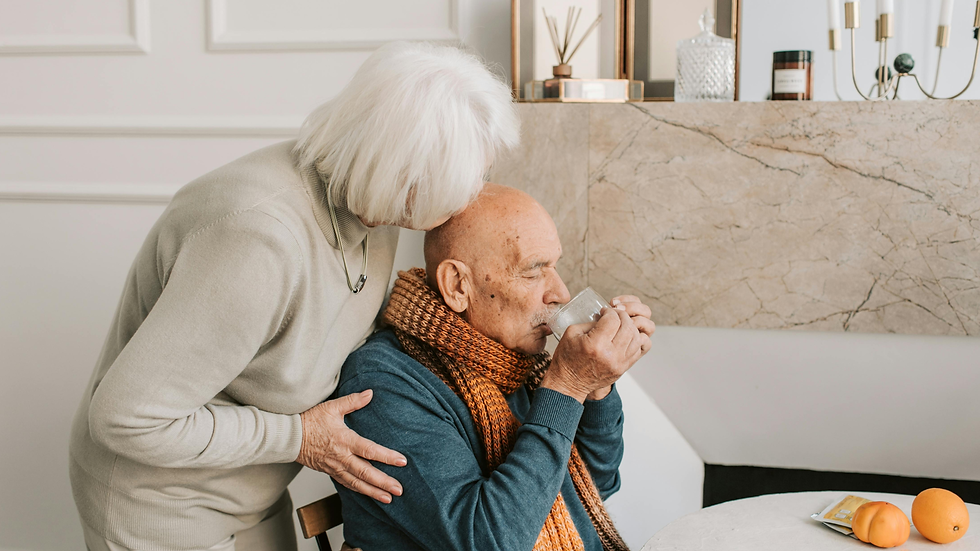
Overtime, people living with dementia are at higher risk for dehydration due to impaired thirst cues, memory changes, and reduced ability to independently access fluids. Even mild dehydration can lead to UTIs, constipation, headaches, dizziness, falls, and sudden worsening of confusion, often mistaken for disease progression.
Recommendation: Schedule fluid intake throughout the day rather than relying on thirst (Li et al., 2023)
Actions:
Serve a full glass of fluid with every meal and snack
Add flavor packets (low sugar) to improve taste and boost electrolytes
Ensure you have the right cup (e.g. brightly colored, easy straw access, etc.)
Offer fluids proactively (e.g. “Here’s your water")
Supplement with water-rich foods like melon, soup, or smoothies

Habit #5: Movement
Daily physical activity supports mobility, balance, mood, sleep, and independence for people living with dementia (Begde et al., 2021). The most effective exercise is one that is safe, fun, and repeatable. Start by adapting activities you already enjoy. When trying something new, prioritize movement that improves balance, strength, and fall prevention, with an emphasis on skills used in everyday life. Exercise can also be paired with other habits, such as socialization or a morning outdoor walk to support circadian rhythm.
Recommendation: Schedule daily exercise at a consistent time.
Actions:
Identify ways to incorporate safe movement into your daily schedule.
Examples of healthy daily movement:
Sit-to-stand exercises
Grocery shopping (you can get a lot of steps in bigger stores!)
Housework (e.g. vacuuming)
Daily walks in familiar environments
Dancing to familiar music
Gardening

Habit #6: Train your Brain
Cognitive engagement involves activities that gently stimulate thinking, attention, and communication in ways that are meaningful, familiar, and success oriented. It is not about testing memory, but about supporting the cognitive skills needed for everyday function. Effective activities naturally engage categorization, sequencing, attention, language, and/or fine motor skills. When embedded into routine, cognitive engagement can reduce apathy, anxiety, and agitation while reinforcing a sense of purpose.
Recommendation: Schedule brief, predictable cognitive engagement daily.
Actions:
Set a goal for completing an activity
Keep activities short (10–20 minutes)
Tailor activities and break down tasks and provide clues as needed to encourage independence
Examples of Cognitive Engagement Activities:
Folding and sorting clothes
Putting away dishes
Cooking together
Singing familiar songs
Simple games

Habit #7: Socialization
Regular social engagement is one of the most powerful lifestyle factors linked to brain health in later life (Joshi et al., 2023). Perhaps this is because human interaction is cognitively demanding, requiring the brain to process language, non-verbal cues, attention, and emotional regulation simultaneously. Luckily, social connection is also one of the easiest habits to integrate into existing routines.
Recommendation: Schedule at least one, meaningful social interaction per day, focusing on active engagement rather than passive observation.
Actions:
Identify your social network, both informal (friends, family, neighbors) and formal (support groups, community programs).
Establish a predictable communication routine, such as a daily or weekly call, shared walk, or regular group meeting.

At Simon, we’ve learned that one of the biggest sources of stress for people living with dementia and their care partners is not knowing what comes next or how to keep the basics on track. That uncertainty can make even simple care feel overwhelming.
So we've built decades of research into our app, to help guide and coach people living with dementia, and their care partners, on staying healthy, happy, and living the lives that they want to live. Through reminders, notifications, and nudges, we keep you on track, feeling confident that you're doing what you can.
Underlying this science-backed coaching, we combine three tools for families to coordinate, reduce mental load, and support autonomy:
A shared task list, so everyone involved can stay aligned on essentials like groceries, medications, and household needs.
An interactive map with location tracking and geo-specific notifications, alerting everyone to emergencies, and keeping the family up to date on where they are and where they’re meant to be, without constant check-ins.
A shared calendar connected to the map, providing reminders for upcoming appointments and alerts for missed ones, helping daily structure stay intact.
By bringing these tools into one central, easy-to-use space, Simon helps ensure no one is navigating daily life alone, whether that’s getting from point A to point B, staying socially connected, or keeping the home running smoothly.
Simon is here to support the basics of daily living, so families can spend less time managing logistics and worrying about emergencies, and more time focused on connection, confidence, and quality of life.
Whether you’re just beginning this journey or already deep in it, you don’t have to figure it out alone. Download the Simon App or Join our community of Simon App Testers.

References
Baker, L. D., Espeland, M. A., Whitmer, R. A., Snyder, H. M., Leng, X., Lovato, L., Papp, K. V., Yu, M., Kivipelto, M., Alexander, A. S., Antkowiak, S., Cleveland, M., Day, C., Elbein, R., Tomaszewski Farias, S., Felton, D., Garcia, K. R., Gitelman, D. R., Graef, S., Howard, M., … Carrillo, M. C. (2025). Structured vs Self-Guided Multidomain Lifestyle Interventions for Global Cognitive Function: The US POINTER Randomized Clinical Trial. JAMA, 334(8), 681–691. https://doi.org/10.1001/jama.2025.12923
Begde, A., Jain, M., Hogervorst, E., & Wilcockson, T. (2022). Does physical exercise improve the capacity for independent living in people with dementia or mild cognitive impairment: an overview of systematic reviews and meta-analyses. Aging & Mental Health, 26(12), 2317–2327. https://doi.org/10.1080/13607863.2021.2019192
Edemekong, P. F., Bomgaars, D. L., Sukumaran, S., & Schoo, C. (2025, May 4). Activities of daily living. StatPearls - NCBI Bookshelf. https://www.ncbi.nlm.nih.gov/books/NBK470404/
Joshi, P., Hendrie, K., Jester, D. J., Dasarathy, D., Lavretsky, H., Ku, B. S., Leutwyler, H., Torous, J., Jeste, D. V., & Tampi, R. R. (2023). Social connections as determinants of cognitive health and as targets for social interventions in persons with or at risk of Alzheimer’s disease and related disorders: a scoping review. International Psychogeriatrics, 36(2), 92–118. https://doi.org/10.1017/s1041610223000923
Li, S., Xiao, X., & Zhang, X. (2023). Hydration Status in Older Adults: Current Knowledge and Future Challenges. Nutrients, 15(11), 2609. https://doi.org/10.3390/nu15112609
Livingston, G., Huntley, J., Liu, K. Y., Costafreda, S. G., Selbæk, G., Alladi, S., Ames, D., Banerjee, S., Burns, A., Brayne, C., Fox, N. C., Ferri, C. P., Gitlin, L. N., Howard, R., Kales, H. C., Kivimäki, M., Larson, E. B., Nakasujja, N., Rockwood, K., . . . Mukadam, N. (2024). Dementia prevention, intervention, and care: 2024 report of the Lancet standing Commission. The Lancet, 404(10452), 572–628. https://doi.org/10.1016/s0140-6736(24)01296-0
Morris, M. C., Tangney, C. C., Wang, Y., Sacks, F. M., Bennett, D. A., & Aggarwal, N. T. (2015). MIND diet associated with reduced incidence of Alzheimer's disease. Alzheimer's & dementia : the journal of the Alzheimer's Association, 11(9), 1007–1014. https://doi.org/10.1016/j.jalz.2014.11.009
Osborne, T., Lowe, T. A., & Meijering, L. (2023). Care and rhythmanalysis: Using metastability to understand the routines of dementia care. Social Science & Medicine, 331, 116099. https://doi.org/10.1016/j.socscimed.2023.116099
Watson, N. F., Badr, M. S., Belenky, G., Bliwise, D. L., Buxton, O. M., Buysse, D., Dinges, D. F., Gangwisch, J., Grandner, M. A., Kushida, C., Malhotra, R. K., Martin, J. L., Patel, S. R., Quan, S. F., & Tasali, E. (2015). Recommended Amount of Sleep for a Healthy Adult: A Joint Consensus Statement of the American Academy of Sleep Medicine and Sleep Research Society. Sleep, 38(6), 843–844. https://doi.org/10.5665/sleep.4716


Comments